Biological Sciences

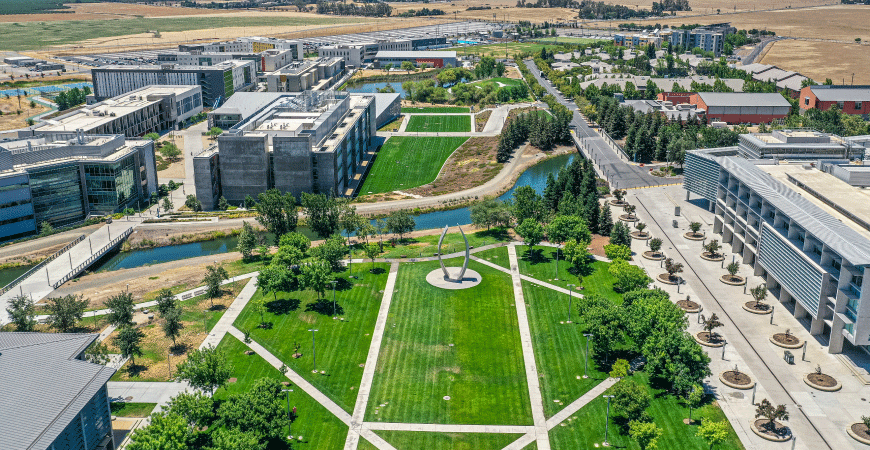
An aerial view of the UC Merced campus displaying a green field, walking paths, and buildings

Paleorecord Critical to Future Conservation Efforts, Scientists Say

The rapid pace of global change has large impacts on nature, and on the work conservation biologists will have before them, too. From here on out, experts say, the fossil record is going to be critical to guide nature into the future. A new paper in the journal Science, co-authored by UC Merced

An aerial view of the UC Merced campus displaying a green field, walking paths, and buildings

Ancient Biological Clockwork Revealed Using ‘Secret Sauce’

In finding a way to see assemblies of the proteins that direct cyanobacterial circadian rhythms, or biological clocks, UC Merced biochemistry Professor Andy LiWang and his colleagues have done what no one else has been able to, despite more than 15 years of trying. A new paper released in the

An aerial view of the UC Merced campus displaying a green field, walking paths, and buildings

Precision Targeting Provides New Insights Into Therapy-Resistant Cancers

The National Cancer Institute’s “cancer moonshot” tasks researchers with, among advancing other new biotechnologies, delving into immunotherapy and epigenomic analysis. UC Merced Professor Fabian V. Filipp is doing his part, further developing his work on precision targeting of cancers and

An aerial view of the UC Merced campus displaying a green field, walking paths, and buildings

Researcher Illuminates the Olfactory Life of Crabs

If you want to know what the ocean really smells like, you’ll have to ask a crab. Yes, crabs have a sense of smell. In humans, chemicals in the air flow into our nasal cavities toward specialized sensory cells. Olfaction occurs when odorant molecules bind to specific sites on the olfactory receptors

An aerial view of the UC Merced campus displaying a green field, walking paths, and buildings

UC Merced Professor Delivers Pellissier Lecture

Everyone is invited to hear UC Merced Professor Clarissa Nobile, this year’s Pellissier Distinguished Speaker, discussing biofilms. “Microbial Films: Why are They Important? How do They Form? And What Does This Mean for You?” looks at biofilms, the predominant growth state of most microorganisms on

An aerial view of the UC Merced campus displaying a green field, walking paths, and buildings

New UC Grant Enables Deeper, Broader Valley Fever Research

Researchers at UC Merced are playing key roles in the new UC Valley Fever Research Initiative, studying how the Valley fever fungus, Coccidioides immitis, causes disease in its mammalian hosts, and identifying the genes involved in this process. School of Natural Sciences professors Clarissa Nobile

An aerial view of the UC Merced campus displaying a green field, walking paths, and buildings

Genetic Changes Made Native Americans Susceptible to Smallpox, Study Shows

A new study identifies genetic changes in Native Americans that came about when Europeans settled in the Pacific Northwest and might have played a major role in why so many natives died of infectious disease. In a new paper in Nature Communications, “ A Time Transect of Exomes from a Native American

An aerial view of the UC Merced campus displaying a green field, walking paths, and buildings

Students Building Living Machines Out of Engineered Tissues

There are many labs at UC Merced where visitors can see students huddled over microscopes and petri dishes, using tweezers to extract and examine different items. But no one at UC Merced has ever seen the likes of what’s going on in Professor Kara McCloskey’s class. The graduate and undergraduate

An aerial view of the UC Merced campus displaying a green field, walking paths, and buildings

Biologist Earns Prestigious Guest Professorship in Germany

Computational biologist David Ardell has been awarded the 2016 Julius Kuehn Professorship by the academic senate of Martin Luther University Halle-Wittenberg in Germany. Ardell, a professor in UC Merced’s School of Natural Sciences, will spend six weeks this summer with his family at the German

An aerial view of the UC Merced campus displaying a green field, walking paths, and buildings

Researchers Find Key to Harmful Pathogen’s Transformation

A team of scientists led by UC Merced Professor Aaron D. Hernday has made a major advancement in understanding how the most common fungal pathogen in humans can alter its cellular phenotype and behavior. Although typically a benign component of the human microbiome, Candida albicans can transition