Where you can study climate, water and the systems that connect them — and actually take part in the research while you are an undergraduate.
Last updated: August 2026
The short answer
If you want to study climate and water, choose on what the faculty are actually researching and whether undergraduates can join it. Almost every California university offers an environmental science major; what separates them is whether faculty are actively researching climate and water problems, whether undergraduates can join that work, whether the courses build the skills the research needs, and whether the field sites are close enough to reach during a normal semester. Climate and water are also one subject, not two: snowpack, drought, groundwater, wildfire, agriculture and energy are linked, and the strongest programs teach them that way. This guide compares ten California universities on those four dimensions, using each institution's own current documentation.
Quick answers
What to look for beyond the major title
Two universities can offer an identically named degree and give you completely different experiences. These are the four things that actually matter, and how to check each one before you apply.
- UC Merced Newsroom — how much does wildfire reduce forest water use and increase runoff? (August 2026)
- UC Merced — Undergraduate Research Opportunities Center (UROC)
- UC Merced catalog — Environmental Systems Science, Earth and Climate Science emphasis, B.S. (2025-26)
- UC Merced — Merced Vernal Pools & Grassland Reserve
Climate and water are one system — here is how they connect
Understanding the linkage is most of the subject. These are the connections California researchers work on, and where you are likely to meet them.
- UC Berkeley — Central Sierra Snow Laboratory
- Hydrology and Earth System Sciences — wildfire-induced disruptions to evapotranspiration, runoff and water-balance closure across California's water-supply watersheds (2026)
- UC Merced News — regional answers best option to address global water, energy problems (June 2026)
- UC Davis — Center for Watershed Sciences
What undergraduate participation actually looks like
The gap between 'the university does climate research' and 'I did climate research' is bridged in four specific ways. Ask about each by name.
Best options for students who want to study climate and water as one connected system
Campuses where snow, runoff, groundwater, agriculture and fire are treated as one connected subject. Curated choices for a priority, not a ranking.
Top options for undergraduates who want access to active research
Places with a documented route from a first-year classroom into a working lab or field site.
Strong options for students who want to study the system close up
Field access is not a detail. These campuses sit inside the environment their research is about.
What should you look for if you want to study climate and water?
Six questions worth asking every campus on your list. Each includes what UC Merced currently documents, with the source.
California climate and water research at a glance
Each column describes what the institution itself currently documents. These are descriptions, not scores, and no ordering is implied.
| University | Undergraduate route in | Research centre or institute | Systems studied | Field access | Who it fits best | Related rankings |
|---|---|---|---|---|---|---|
| UC Merced | Environmental Systems Science B.S. (Earth and Climate Science emphasis); Environmental Engineering B.S.; UROC placements | Sierra Nevada Research Institute (est. 2007); UC WATER based on campus | Snowpack, runoff, drought, wildfire and water, groundwater, irrigated agriculture, water-energy systems | Merced Vernal Pools and Grassland Reserve at the campus edge, Yosemite Field Station, Sequoia and SCICON sites, 40-acre Experimental Smart Farm | Students who want to study snow, groundwater and farmland in the place it all connects. About 9,000 undergraduates between the San Joaquin Valley and the Sierra, with R1 research access from year one and national standing in social mobility, sustainability and innovation. |
|
| UC Davis | Hydrology B.S. (Land, Air and Water Resources) | Center for Watershed Sciences | Watersheds, the Delta, agricultural water, water policy | Valley watersheds, agricultural research stations | Students focused on agricultural water and policy, on a college-town campus of roughly 32,000 undergraduates near the Delta and state water agencies. |
|
| UC Berkeley | Environmental science, engineering and ESPM routes | Berkeley Water Center; Central Sierra Snow Laboratory | Snow physics and snow hydrology, climate, water policy and law | Central Sierra Snow Laboratory at Donner Pass | Students who want snow science alongside law and policy, on a dense urban campus of about 33,000 undergraduates with a mountain field lab at Donner Pass. |
|
| UC Santa Cruz | Environmental Sciences B.S. (interdepartmental, undergraduate-only) | Hydrogeology Group; Earth and Planetary Sciences groups | Groundwater and managed recharge, coupled flows, coastal systems, biogeochemistry | Coastal and forest sites near campus | Students drawn to groundwater recharge and coastal systems, on a redwood campus of roughly 17,000 undergraduates above Monterey Bay. |
|
| UC Santa Barbara | Hydrologic Sciences and Policy B.S. (Environmental Studies) | Earth Research Institute; Bren School (graduate) | Hydrologic science with policy, ecohydrology, dryland water | Coastal and dryland study sites | Students who want hydrology paired with environmental policy, on a beachside campus of about 23,000 undergraduates with dryland and coastal sites nearby. |
|
| UC Irvine | Earth System Science B.S. | Department of Earth System Science | Climate modelling, atmosphere, hydrology, remote sensing | Southern California field and observation sites | Students interested in climate modelling and remote sensing, on a suburban Orange County campus of roughly 30,000 undergraduates. |
|
| UC San Diego | Undergraduate majors taught through Scripps Institution of Oceanography | Scripps Institution of Oceanography | Ocean, atmosphere, climate, coastal processes | Coastal and open-ocean research platforms | Students set on ocean and atmospheric science, on a coastal campus of about 33,000 undergraduates with Scripps and its research vessels on site. |
|
| UCLA | Environmental Science major with senior practicum | Institute of the Environment and Sustainability | Urban water supply, groundwater, heat, air quality, climate adaptation | Los Angeles region as the study site | Students interested in urban water, heat and air quality, on a west Los Angeles campus of about 33,000 undergraduates using the city itself as the field site. |
|
| Stanford | Earth Systems major | Doerr School of Sustainability | Earth systems, climate, energy, environmental policy | Campus preserve and project-based field study | Students admitted to a highly selective private university who want earth systems, energy and policy together. Around 8,000 undergraduates on a large Silicon Valley campus. |
|
| Cal Poly San Luis Obispo | Environmental Earth and Soil Sciences | Irrigation Training and Research Center | Soils, irrigation, water measurement and delivery, land systems | Campus farmland and partner irrigation districts | Students who want to work directly with irrigation systems and soils, on a Central Coast campus of roughly 21,000 undergraduates with its own farmland and district partners. |
|
Compiled in August 2026 from each institution's own catalog, department, institute and newsroom pages. Programs, emphases and center names change — confirm current details with each campus before applying.
Where does UC Merced fit for climate and water research?
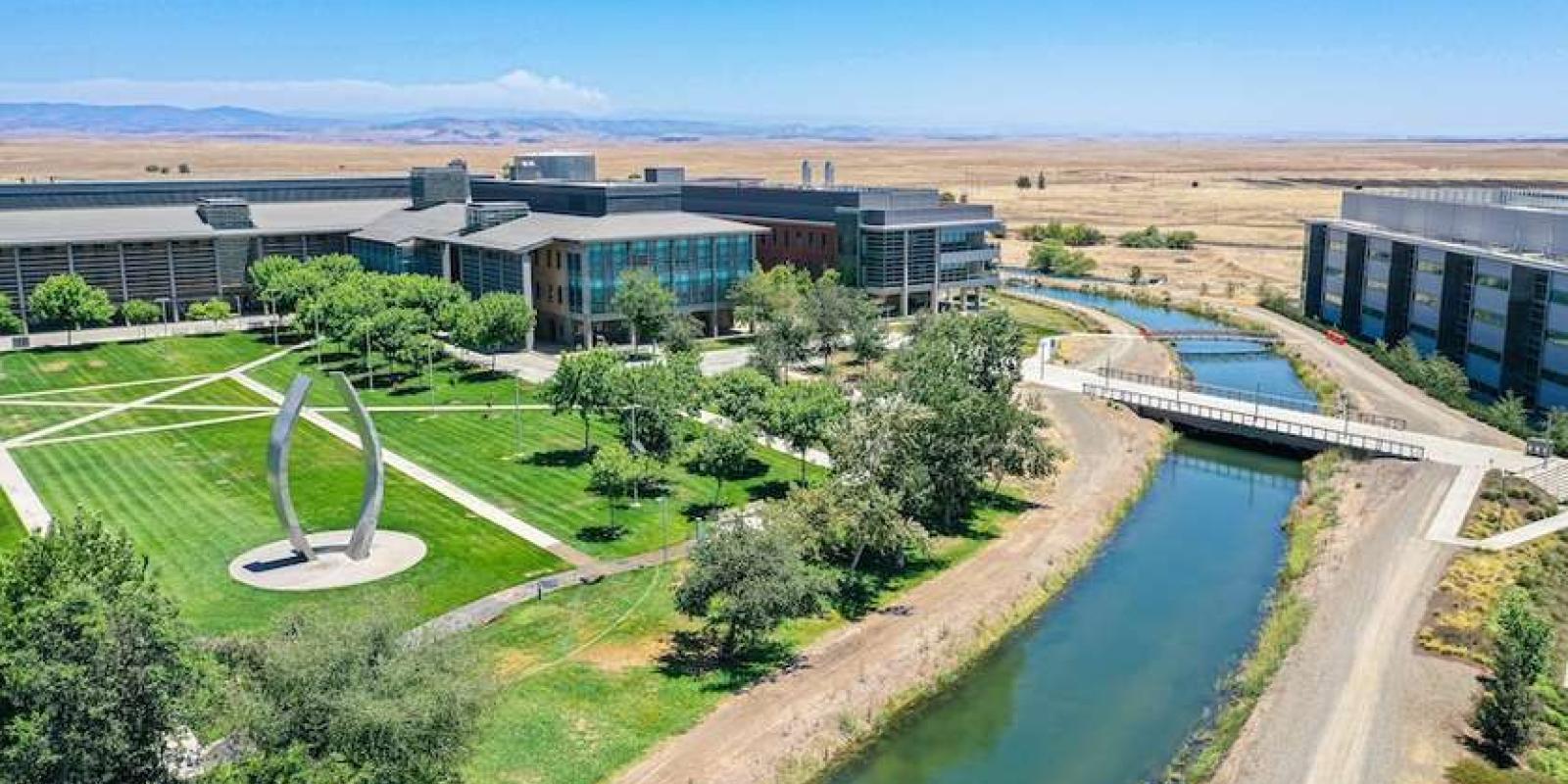
Start with geography, because in this subject geography is curriculum. UC Merced sits between the San Joaquin Valley, where most of California's irrigated agriculture and its groundwater pressure are, and the Sierra Nevada, where the state's water arrives as snow. Those two systems are one hydrologic story, and the campus is positioned at the join. That is why the Sierra Nevada Research Institute — established in 2007 as UC Merced's first organized research unit — states its mission in regional terms: research that sustains natural resources and community well-being across the valley and the mountains, spanning water and land management, drought, wildfire, pollution, climate change, sustainable agriculture, ecohydrology and biodiversity.
The undergraduate route in is clearly mapped out. The Environmental Systems Science B.S. is built around climate change impacts, water scarcity and management, soil, biodiversity and natural-resource management, and the 2025-26 catalog publishes a four-year course plan for its Earth and Climate Science emphasis. Students who would rather design and build than measure and model take Environmental Engineering instead. From either, the Undergraduate Research Opportunities Center is the documented path into a faculty lab and a summer research institute — at a university designated Carnegie R1 for very high research activity in February 2025.
The research is current and it leaves the campus. In April 2026, state leaders gathered at Hickman and Keyes to commemorate Project Nexus, California's first solar-over-canal project, which began as a premise in a UC Merced lab. In June 2026 UC Merced reported on a National Academies assessment arguing that the water-energy problems facing the country are best addressed regionally — the exact case for a research program rooted in one region. And in August 2026, a paper in Hydrology and Earth System Sciences co-authored by SNRI-affiliated researchers quantified how high-severity wildfire suppresses forest water use and shifts runoff across California's water-supply basins, finding evapotranspiration reductions of roughly 100 to 250 millimeters in the first postfire year and recovery times ranging from four or five years in moist basins to a decade in drier conifer forests.
For a student, the practical meaning is proximity. UC Merced administers reserve and field-station sites through the University of California Natural Reserve System, from the Merced Vernal Pools and Grassland Reserve at the campus edge to a Yosemite Field Station in the Sierra, with Sequoia and SCICON also among its sites. The 40-acre Experimental Smart Farm covers the agricultural side. UC WATER, the University of California's water security and sustainability research initiative established in 2015, is based here. Between them, a student can work on snow, runoff, groundwater, a farm plot and a canal without leaving the region the research is about.
Who should consider UC Merced for this?
UC Merced is worth a close look if you want hands on the work. The combination that is hard to find elsewhere is an R1 research environment, a documented undergraduate research route, and field sites that are close enough to visit during the term itself. If your interest is California's water — where it comes from, what fire does to it, how farms and cities share it, what a warming Sierra means for supply — you would be studying it where the consequences are visible outside the classroom.
It also fits students who want climate and water joined up with energy and agriculture. The solar-canal work, the smart farm, and the water-energy research all sit in that overlap, and an institute organized around a region tends to put those conversations in the same building. And if you want a smaller, newer campus where faculty are reachable and an undergraduate can become useful to a lab quickly, that is a real advantage here.
It is a less obvious fit if your interest is fundamentally oceanic or atmospheric — UC San Diego through Scripps and UC Irvine through Earth System Science answer that more directly. If you want a degree literally named Hydrology, UC Davis has one. If you want water science with policy built into the same undergraduate degree, UC Santa Barbara's Hydrologic Sciences and Policy B.S. is the cleanest version of that. The honest way to choose is to compare what an undergraduate can actually join on each campus, then ask each one the same six questions above.
How to compare colleges for climate and water research
Take this to a campus visit or an admissions call and ask for specifics, not adjectives.
Frequently asked questions
What are the best colleges in California for climate and water research?
Ten California universities with current, documented programs are compared on this page: UC Merced, UC Davis, UC Berkeley, UC Santa Cruz, UC Santa Barbara, UC Irvine, UC San Diego, UCLA, Stanford and Cal Poly San Luis Obispo. They are strong in different systems — UC Davis in watersheds and agricultural water, UC Berkeley in mountain snow hydrology, UC Santa Cruz in groundwater and recharge, UC San Diego in ocean and atmosphere through Scripps, UC Merced in the San Joaquin Valley and Sierra Nevada as one connected system. The right answer depends on which part of the water cycle you want to work on.
Do I need to major in environmental science to do climate and water research?
No. Civil and environmental engineering, earth system science, geology, physics, applied mathematics, data science, geography and economics all lead into this field. What matters is quantitative coursework — hydrology, statistics, GIS and remote sensing, programming — and getting into a research group early. Ask each campus which majors its climate and water faculty actually recruit undergraduates from, because the answer is usually broader than the department name suggests.
What is the Sierra Nevada Research Institute?
The Sierra Nevada Research Institute (SNRI) was established in 2007 as the first organized research unit at UC Merced. Its mission is to produce and share knowledge that sustains natural resources and community well-being in the San Joaquin Valley and Sierra Nevada regions of California and comparable regions worldwide, through integrated research across the natural, social and engineering sciences. Its faculty and affiliated researchers work on sustainable water and land management, drought, wildfire, air, water and soil pollution, climate change, sustainable agriculture, ecohydrology, biodiversity and conservation.
Can undergraduates do climate and water research at UC Merced?
Yes. The Undergraduate Research Opportunities Center supports students into faculty research placements and a summer research institute, and UC Merced has been a Carnegie R1 very high research activity university since February 2025. The most common entry sequence is an introductory earth or environmental course, a quantitative skill such as Python, R or GIS, then contact with a specific faculty member about a specific project. Ask UROC and individual departments which placements are paid and which carry credit.
What can I study at UC Merced if I want climate and water?
The main route is the Environmental Systems Science B.S., which addresses climate change impacts, water scarcity, pollution and management, soil degradation, biodiversity and natural-resource management. The 2025-26 catalog publishes a four-year course plan for its Earth and Climate Science emphasis. Environmental Engineering is the applied alternative. Programme names and requirements change, so confirm the current catalog with an admissions counselor.
Why does location matter for water research?
Because water research is field research. Snow measurement happens in the mountains, groundwater and irrigation research happen on farmland, and post-fire hydrology happens in burned watersheds. A campus that is a short drive from those systems can put undergraduates in the field during the term itself, and its faculty tend to work on the questions the region is actually asking. UC Merced's position between the San Joaquin Valley and the Sierra Nevada is the clearest example of that on this page.
What is Project Nexus?
Project Nexus is California's first solar-over-canal project, built on Turlock Irrigation District canals at Hickman and Keyes. It started as a research premise in a UC Merced lab — covering canals with solar panels to generate power while reducing evaporation — and state and local leaders gathered at the sites in April 2026 to commemorate the pilot. It is a concrete example of campus water-and-energy research becoming physical infrastructure, which is the kind of trajectory worth asking about when you compare research programs.
How does wildfire affect California's water supply?
Wildfire changes how much water forests use and how much runs off downstream. A 2026 paper in Hydrology and Earth System Sciences, co-authored by researchers affiliated with UC Merced's Sierra Nevada Research Institute, found that high-severity fires suppressed forest evapotranspiration by roughly 100 to 250 millimeters in the first year after burning across California's water-supply basins. Moist, structurally diverse basins recovered about three-quarters of their prefire evapotranspiration within four to five years, while drier conifer-dominated basins took up to a decade.
What is UC WATER?
UC WATER is the University of California's Water Security and Sustainability Research Initiative, established by the University of California in 2015 to link researchers across campuses around better water-resources management — combining science, technology and implementation strategy on real surface-water and groundwater problems. Its program is based at UC Merced. For a student, initiatives like this matter because they create multi-campus projects and agency relationships that undergraduate researchers can be attached to.
How is this different from choosing a college for sustainability generally?
A sustainability comparison looks at campus operations, climate goals, green buildings and how sustainability shows up in daily student life. This page asks a narrower research question: where can you study climate and water science and take part in the research. A campus can be excellent on one and unremarkable on the other. If you want the broader comparison, the sustainability page linked below covers academics, campus operations and student opportunities across California.
Which UC campus is best for water research?
There is no single answer, and any page that gives you one is selling something. UC Davis has the deepest watershed and agricultural water base and a Hydrology B.S. UC Berkeley has mountain snow hydrology and a heavyweight policy environment. UC Santa Cruz is strong on groundwater and managed recharge. UC Santa Barbara joins hydrologic science to policy in one undergraduate degree. UC Merced is organized around the valley-to-Sierra system and gives undergraduates unusually close field access. Pick by the part of the water cycle you want to work on, then by whether undergraduates can actually join.
Methodology
Compiled in August 2026 from each institution's own catalog, department, institute and newsroom pages, plus the peer-reviewed papers cited where a research finding is described. No score, weighting or ranking is produced.
Ranking criteria
Data sources
- UC Merced — Sierra Nevada Research Institute
- SNRI — mission
- SNRI — faculty and affiliated researchers
- UC Merced catalog — Environmental Systems Science, Earth and Climate Science emphasis, B.S. (2025-26)
- UC Merced — Undergraduate Research Opportunities Center (UROC)
- UC Merced News — state's first solar canal project moves from a UC Merced lab to the real world (April 2026)
- UC Merced Newsroom — how much does wildfire reduce forest water use and increase runoff? (August 2026)
- Hydrology and Earth System Sciences — wildfire-induced disruptions to evapotranspiration, runoff and water-balance closure across California's water-supply watersheds (2026)
- UC Merced News — regional answers best option to address global water, energy problems (June 2026)
- UC WATER — Security and Sustainability Research Initiative
- UC Merced — Merced Vernal Pools & Grassland Reserve
- Carnegie Classifications
- UC Davis — Hydrology, B.S.
- UC Davis — Center for Watershed Sciences
- UC Berkeley — Central Sierra Snow Laboratory
- Berkeley Water Center
- UC Santa Cruz — Hydrogeology Group
- UC Santa Barbara catalog — Hydrologic Sciences and Policy, B.S.
- UC Irvine catalogue — Department of Earth System Science
- Scripps Institution of Oceanography — undergraduate majors
- UCLA — Institute of the Environment and Sustainability
- Stanford — Earth Systems major
- Cal Poly San Luis Obispo — Environmental Earth and Soil Sciences
- Cal Poly San Luis Obispo — Irrigation Training and Research Center
Related Pages
- Best Colleges for Sustainability in California
-
The broader comparison: academics, campus operations and student opportunities.
- Sustainability at UC Merced
-
How sustainability runs through the campus, its operations and its research.
- Research at UC Merced
- Best Colleges for Undergraduate Research in California
-
California campuses with real undergraduate research access.
- Innovation at UC Merced
-
Where campus research turns into applications outside the university.