
Regional Answers Best Option to Address Global Water, Energy Problems

A new report from the National Academies of Sciences, Engineering, and Medicine calls for the U.S. Department of Energy to develop innovative technology and infrastructure at the intersection of the nation's water and energy systems.
The country's energy and water systems are profoundly interconnected, and disruptions can cascade rapidly across both, says the report from the Committee on Enabling DOE Regional Energy-Water Technology Pilots.
"The Western United States, particularly California, is locked in a balancing act to secure water and energy without sacrificing environmental health," said UC Merced civil and environmental engineering Professor Safeeq Khan, who is a member of the committee and contributed to the report. "Because these two sectors are deeply interconnected, a shift in one dynamically impacts the other."
These systems affect public health, economic activity, environmental quality and national security, the report found.
Energy and water systems are often managed separately, however, and regional environmental, socioeconomic and political conditions can vary widely, making a single national approach inadequate to address the range of challenges facing the systems.
"California's mountains - the state's natural water towers - are changing in ways that will alter the storage and movement of water resources, as well as hydropower generation and consumption," Khan said. "Simultaneously, the region is grappling with an escalating wildfire crisis."
And new challenges are always arising.
In recent years, data centers have placed increasing strain on the electric grid and used significant quantities of water in some areas, while other stressors, such as extreme weather, are testing aging infrastructure and exposing systemic vulnerabilities. The report points to Winter Storm Uri in 2021, during which prolonged power outages disrupted water treatment and distribution across Texas, to underscore how coupled energy and water systems are.
"The breadth of challenges and contexts across the energy-water nexus are extraordinary and will take a multipronged approach to address," said Katharine Jacobs, chair of the committee that wrote the report, director of the Center for Climate Adaptation Science and Solutions and professor of environmental science at the University of Arizona. "Our report offers a foundation for DOE to integrate cross-sector collaboration and regional knowledge to protect and strengthen our communities and country."
Pilot programs could demonstrate technologies that advance resilience and reduce structural risks to energy and water systems, the report says. In addition, pilot programs could improve access to energy and clean water, as well as create skilled jobs. The report provides strategies for how to build a suite of pilot projects and ensure that investments yield measurable, long-term benefits and mitigate risk.
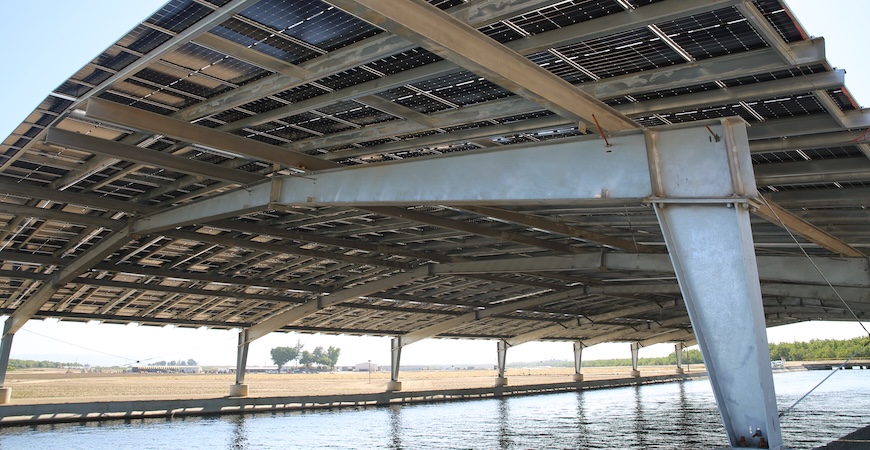
Some of those pilot programs are already in development. In the Northern San Joaquin Valley, UC Merced is a partner in Project Nexus, a first-in-the-state effort to examine the costs and benefits of erecting solar panels over irrigation canals.
"There is a real opportunity to invest in distributed water-energy infrastructure," Khan said. "Key strategies include developing rural, bio-based energy facilities that improve grid reliability while creating markets for forest fuel management and agricultural waste; deploying technologies that optimize and conserve water and energy simultaneously, rather than one at the expense of the other; and aligning pumped storage with offsite reservoirs."
The absence of a specific federal agency dedicated to water management issues that can centralize, coordinate and evaluate data has hindered the federal government's ability to develop cohesive, cross-sector water programs, the report notes.
At the same time, water management decisions are inherently local and context-specific, shaped by regional hydrology, governance structures and community needs, making a fully centralized approach neither practical nor desirable.
However, within this landscape, entities such as DOE's Hydropower and Hydrokinetic Office can serve as conveners and coordinators at the federal level without supplanting state, tribal and local authorities. DOE should focus on creating management structures that align budgets and strategies, extend existing benefits withoutduplicating effort, and foster collaboration, transparency and partnerships with industrial and agricultural partners, the report says.
The National Academies of Sciences, Engineering, and Medicine are private, nonprofit institutions that provide independent, objective analysis and advice to the nation to solve complex problems and inform public policy decisions related to science, engineering and medicine. They operate under an 1863 congressional charter to the National Academy of Sciences, signed by President Abraham Lincoln.