
What Do Driverless Cars and Building Evacuation Routes Have in Common? A Lab at UC Merced
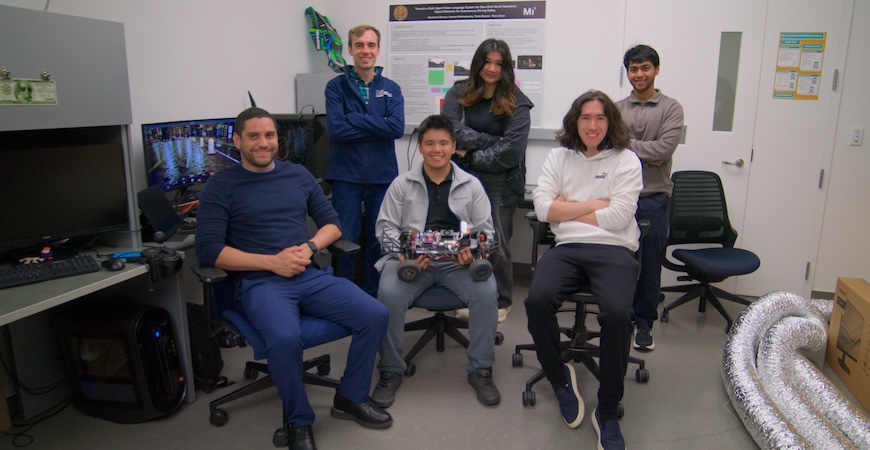
Step into Ross Greer’s lab — gingerly, because there’s a makeshift racetrack on the floor — and you will see multiple projects aimed at making autonomous vehicles smarter and safer.
And these projects are getting global recognition.
A team from the lab earned the top prize at the National Highway Transportation Safety Institute Enhanced Safety of Vehicles conference this spring in Toronto, Canada. UC Merced’s team was one of three from the U.S. selected to advance from the preliminary round and compete at the NHTSA conference.
They also are competing at the Institute of Electrical and Electronics Engineers’ Intelligent Vehicle Symposium in Detroit this summer.
In addition, Greer recently received a $200,000 grant from the Alliance of Hispanic Serving Research Universities toward developing autonomous systems for resilient human–machine teaming.
During a tour of the lab, it swiftly becomes apparent that this is groundbreaking work.
“This is our RoboRacer — a fully autonomous race car,” said Greer, a computer science and engineering professor.
As the RoboRacer zipped around a course made up of boxes and flexible HVAC ducting, it avoided both the stationary obstacles and the people who stepped in its way.
“It has no clue it’s going in a loop right now,” student Angel Martinez-Sanchez said. “It senses people. .”
A camera atop the car senses obstacles — those placed in its path and those that might suddenly enter, such as a pedestrian or oncoming car. But the processor also can map the area where it’s going, so it can determine the proper speed. The processor has a few different modes it can operate in, Martinez-Sanchez said.
The team is using processors provided by AI giant NVIDIA through a grant awarded earlier this year.
“Once I have the map on, it understands it can book it down the hall and slow at the corners,” Martinez-Sanchez said.
Another team is working on a project that improves the real-time sharing of traffic and other information.
Many of the data sets (currently available) are from one point of view. Their app would analyze input from various points to provide a fuller picture of the situation.
“It’s an app that can connect to the vehicle’s camera and can connect to another computer,” student Parthib Roy said.
If the camera picks up indications that the car is entering a work zone, it chimes adetection alert to the driver.
Sharing those kinds of alerts across a broader system is the topic of another project. It replicates traffic conditions and hazards you might see in a smart phone map, but they are updated in real time and shared with a group of devices. So if there’s a caravan heading to a location and along the way there’s a sudden traffic jam or a log in the road, the lead car would alert the others.
“The biggest thing is scalability,” student Kianna Ng said. “Right now, this is all local.”
The program shows the car detecting signs, work vehicles, cones and workers.
Another project takes the processor out of the car and puts it into other parts of life.
Working off previous research into autonomous driving, student Wesley Maia built a system that can tell mobility device users if a sidewalk is suitable for them. Current systems might mark road work, for example, but wouldn’t have information about sidewalks and steps.
Another project can help people escape buildings in emergency situations.
Evacuations can be chaotic and difficult, and even more so for the visually impaired.
“We’ve collected a ton of evacuation data,” Maia said. And they used it to develop a system that can help people determine where to go if, for example, one escape route is suddenly blocked by flames.
“We built a decision tree refiner,” student Cristian Parker said. “It can devise alternate routes for you.”
The decisions are made quickly using real-time data that could save vital seconds in the chaos of an emergency.
“One of the most rewarding parts of this work is watching students realize that the technology behind autonomous vehicles can have impact far beyond cars,” Greer said. “The same AI systems that help a vehicle understand its surroundings can also help people navigate emergencies, improve accessibility, and make transportation safer for everyone, and our students are dedicated to making these AI systems trustworthy to the communities they serve.”