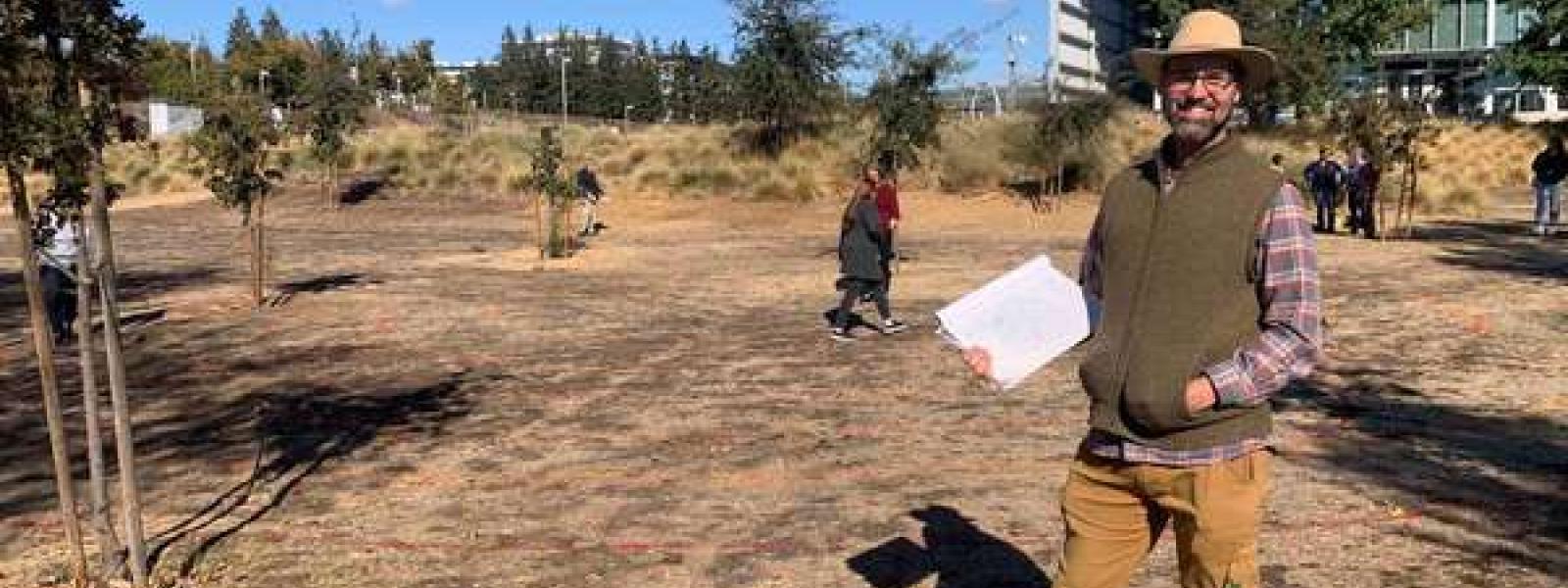
A temporary labyrinth has taken shape on the UC Merced campus.
The labyrinth, which is an ancient pattern people walk to reflect, was
built by master designer Lars Howlett. Marked by spray paint now,
once the final design is determined, the path will be delineated by river
rocks and decomposed granite.
Walking a labyrinth is a different experience for everyone. Some people
meditate, some pray and some just take a break from their day to reset.
Those who approach the labyrinth are invited to take it by whatever means
they see fit in the moment, Howlett said. Labyrinths are meant to create
time and space to reconnect with oneself, the environment and the
community.
“You can run it, dance it, skip it,” he said, “whatever energy your spirit
and you want to bring to the walk.”
UC Merced’s 65-foot labyrinth is in the pattern of the Baltic Wheel, with
an additional “triple meander” built into it, Howlett said. It took him
roughly three hours to set up the temporary design.
The idea isn’t to get lost, like a maze, but to intentionally walk the
complicated pattern while allowing your mind to wander. Labyrinths are
generally designed flat on the ground, with the design and destination in
full view from the entrance.
Once the walker reaches the center of the Baltic Wheel design, an immediate
exit is available. But many people choose to walk back through the way they
came to close out their experience.
“It depends on how much time you have or where your energy is on a given
day,” Howlett said.
There are four phases of walking a labyrinth, according to the nonprofit
Veriditas, an organization aimed at inspiring change through the labyrinth
experience. Remember is before walking the path, release is walking the
pattern itself, receive is in the center of the labyrinth and return is
walking out.
The labyrinth is open to everyone and provides a different experience to
all who walk it, said De Acker, programs development director at UC Merced.
“Sometimes I have a question that I am thinking about and I walk a
labyrinth,” she said. The idea isn’t to concentrate on the question at hand
but to get away from it. At the end of the path, the answer might be
apparent anyway.
Even for those who aren’t trying to grapple with questions or problems, the
labyrinth can serve as a refuge.
“It’s a place to release all the busyness of the day,” Acker said.
A group of stakeholders has been meeting to find the right spot for the
labyrinth. They ultimately chose Kelley Grove, which previously was
underutilized, Acker said. The grove is located near Little Lake next to
the Pavilion.
The spot is ideal for a labyrinth because it’s easily accessible and
adjacent to trees, water and buildings.
She said the temporary pattern should last at least a week. It remained
visible after the recent rains the area experienced. Once the design is
finalized, construction on the permanent path will begin. It’s expected to
be in place ahead of World Labyrinth Day on May 6.
Media Contact